
Career Services Guide: Supporting People Affected by Mental Health Issues
July 8, 2026From My Perspective: Guide to Career/Employment Centre Management
July 9, 2026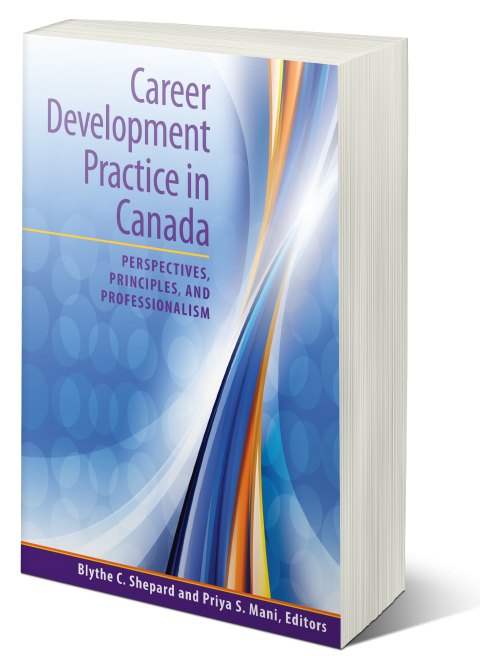
Get your copy!
Career Development Practice in Canada: Perspectives, Principles, and Professionalism
Synopsis
With a Foreward by Norman Amundson, contributors are internationally recognized experts and thought leaders in the career development field in Canada including: Phil Jarvis, Roberta A. Neault, Nancy Arthur, Bryan Hiebert and Kris Magnusson.
Featuring 22 chapters in 7 sections:
- Section 1: Development of the Profession.
- Section 2: Basic Conceptual Frameworks of Career Development Practice.
- Section 3: The Nuts and Bolts of Career Development Practice.
- Section 4: Working with Diversity.
- Section 5: Navigating Developmental Tasks and Pathways.
- Section 6: Specialties in the Profession.
- Section 7: New Directions and Emerging Trends in Career Development Practice
Includes: Stop-and-Reflect moments to apply the material; a glossary of key terms; references with web links; discussion and activities for individuals and groups; and resources and supplementary readings.
Created for use in curriculum and training by:
- College and university programs in career development at both an undergraduate and graduate level
- Other college and university programs/courses that want to include a career development segment
- Private trainers and training institutions focusing on career development
- Associations in the field offering continuing education
- Plus, individual career practitioners seeking to further their knowledge
The book has been designed to be a learning tool for students, a resource for educators and a reference for career practitioners in the field.
Get your copy
Textalks
A series of monthly discussions with authors of CERIC’s new Career Development Practice in Canada textbook. We bring you insights from thought leaders in the career development field.
Episode 1 (April 22, 2014) – Phil Jarvis
Phil is the Director of Global Partnerships at Career Cruising, which provides career exploration and planning resources to over 20,000 schools, libraries and employment centres. As the author of CHOICES in the late 1970s, Phil was an early pioneer of computer-based career exploration and planning. He also co-authored Blueprint for Life/Work Designs and co-created The Real Game Series. His programs have helped millions of students transition from school to success.
Phil’s chapter in the Career Development Practice in Canada textbook is “Career Development: Key to Economic Development.”
Topics covered in the podcast include:
- Workforce skills gaps and why our current processes to match people with jobs and meaningful careers remain so inefficient
- Connecting curriculum at the K-12 level to careers
- Drop-out rates and why the majority of students in Canada do not pursue post-secondary education
- Are we producing graduates that lack essential employability or soft skills?
- Why so many adults go through their entire working lives without ever making fully intentional career choices
- The responsibility that employers have for training in the labour market
- Implications of demographic changes for Canada: Baby Boomer retirements, a smaller cohort of Millennials entering the workforce, immigration levels that won’t meet labour market demands and Canada’s growing Aboriginal youth population
- The “One-Percent Difference” and the social and economic costs of poor career development
- How can we know the jobs of the future and what skills will be in demand
- The new career management paradigm and the role of career development professionals within it
Episode 2 (May 27, 2014) - Roberta Neault
Roberta Neault is President of Life Strategies Ltd. Roberta is an award-winning career counsellor and counsellor-educator. She is the co-author of the Career Engagement model, and has written many practical guides and workbooks for career practitioners and clients in transition. She is also the Associate Dean of the Faculty of Behavioural Sciences at Yorkville University, and she divides her time between teaching, counselling/coaching, research, writing and presentations within Canada and around the globe.
Roberta’s chapter in the Career Development Practice in Canada textbook is “Theoretical Foundations of Career Development.” She recently completed a term as editor of the Journal of Employment Counseling and the final issue under her leadership was “Thoughts on Theories” — a compilation of new articles from authors of many of the theories referenced in her chapter in the textbook.
Topics covered in the podcast include:
- What is a career development theory and what is intended to do (and why a jigsaw puzzle is such a good analogy)
- Why some career development practitioners don’t consider the use of theories as important to their work
- Are earlier career development theories, such as Parson’s Trait-Factor Theory and Holland’s Theory of Vocational Types, still relevant today?
- The continuing popularity of Super’s Life Stages approach – and why he was ahead of his time
- How newer theories, such as Krumboltz’s Happenstance Theory or Bright and Pryor’s Chaos Theory, can help career development professionals support their clients
- What can a theory like Arthur and Collins’ Culture-Infused Counselling tell us about the cultural beliefs of career development professionals themselves?
- Models of career responsiveness and how they relate to the constantly changing environment and its effect on individual career choice
- Why there seems to be a surge of interest in career development theory when it isn’t always integrated into practice
- Some first steps that career professionals can take to ensure that career theory is applied in their everyday activities
Episode 3 (July 21, 2014) - Mark Franklin
Mark Franklin is practice leader of CareerCycles. He developed the CareerCycles method of practice and trains career professionals in the method, towards the Holistic Narrative Career Professional designation. He presents nationally and internationally and hosts the weekly Career Buzz radio show. Prior to leading CareerCycles, Mark worked as a career counsellor at the University of Toronto and York University, where he redeployed many transferable skills from his earlier career in engineering and management consulting.
Mark’s chapter in the Career Development Practice in Canada textbook is “CareerCycles: A Holistic and Narrative Method of Practice.”
Topics covered in the podcast include:
- How the CareerCycles narrative approach is different from more traditional assessments
- Why a maple tree is a good metaphor for this method of practice
- Engaging the client as an expert storyteller
- What is a Career Sketch and how clients feel relief at “connecting the dots” of their career story
- The role of the career professional in helping to reframe negatives as positives
- Why every Canadian should have a Career Statement and revisit it annually
- What is “career pain”
- How people need to move beyond equating job with career and think about their lives holistically to include their relationships and their interests outside of work
- Encouraging clients to “look for clues” as they explore new career opportunities
- Why “transferable skills” is a concept still not well understood by clients generally
- What groups benefit most from this method of practice
- The skills that practitioners themselves need to successfully use this narrative system
Episode 4 (August 11, 2014) – Sandra Boyd & Kim Spurgeon
Sandra Boyd is a principal and career solutions lead in the Toronto head office of Knightsbridge. Sandra specializes in Career Management, Career Transition, and the Four Generations in the Workplace. She is the author of The Hidden Job Market and co-author of The Flexible Thinker Guide to Extreme Career Performance.
Kim Spurgeon is a vice president at Knightsbridge. She is a certified coach who specializes in career management, career transition, and executive coaching. Kim and Sandra successfully developed and now co-lead the Knightsbridge career management practice.
Sandra and Kim’s chapter in the Career Development Practice in Canada textbook is on “Lifelong Career Management.”
Topics covered in the podcast include:
- How has the approach to managing our careers evolved today compared with even 10 years ago?
- The difference between marketability and employability
- Why employees are more empowered now than at any time in the history of the corporate workplace
- The concept of career fluidity (and how it replaces the career ladder)
- How career management (and our definition of career success) changes over the ages and stages of the life cycle?
- The “Five Steps” to managing any career
- Knightsbridge’s career management model and the three-way partnership between manager, organization and employee
- What developing your “brand” really means and some tips to make it happen
- How social media has changed how we build our networks
- Why job hopping (working for organizations for one to two-year stints) is on the rise and no longer holds a negative connotation
- How employers who want to recruit and retain top talent are having to work harder to provide opportunities for career development
Episode 5 (September 18, 2014) – Dr Nancy Arthur
Dr Nancy Arthur is a Professor and Associate Dean Research, Educational Studies in Counselling Psychology, Werklund School of Education, University of Calgary. She began her education in a one-room school house in Southern Ontario and those early years sparked curiosity about diversity and social justice. Nancy co-authored the award-winning book Culture-Infused Counselling. She is also a registered psychologist and works with clients in private practice.
Her chapter in the Career Development Practice in Canada textbook (along with Athabasca University’s Sandra Collins) is on “Diversity and Social Justice.”
Topics covered in the podcast include:
- How cultural identity impacts the way a practitioner sees a client
- Allowing stereotypes to unintentionally influence your work
- How to become familiar with diverse cultural beliefs and practices
- The importance of exploring each client’s unique worldview and not defining them by their group membership
- Different perceptions of career development among various cultures and why career counselling itself can be viewed as elitist
- Availability of culturally relevant career development services in Canada today
- How many of the theories and models used today in career development reflect a Western worldview
- Applying the Culture-Infused Counselling model
- Why recognizing diversity is not enough to be a competent career practitioner
- The responsibility that career development professionals have to advance social justice
- Why career development practitioners may inadvertently support the status quo by helping clients adapt to oppressive conditions
Episode 6 (November 4, 2014) – Bryan Hiebert & Kris Magnusson
Bryan Hiebert is a Professor Emeritus of Education, University of Calgary, and Adjunct Professor in Educational Psychology and Leadership Studies at the University of Victoria. He is a member of the Canadian Working Group on Evidence-Based Practice in Career Development and part of the co-ordinating team for Prove It Works, an international initiative aimed at demonstrating the value of career development programs and services.
Kris Magnusson is a Professor of Counselling Psychology and Dean of the Faculty of Education at Simon Fraser University. He is also a founding member of the Canadian Research Working Group on Evidence-Based Practice in Career Development, dedicated to improving the evidence base for the impact that career services have at individual, community, social and economic levels.
Their chapter in the Career Development Practice in Canada textbook looks at how practitioners and the career development field as a whole can show that what they do makes a difference.
Topics covered in the podcast include:
- Is vulnerability to funding cuts the biggest motivator for departments and agencies to adopt an evidence-based approach?
- Why 90% of managers and practitioners in career development say that evaluation is important but only 35% actually evaluate the impact of their work
- How it is “neither professional nor ethical to do things with a client with no evidence to support it”
- Moving beyond asking if a client found a session useful or tracking changes in employment status, to an approach where evaluation is infused into day-to-day practice
- How the best way to evaluate the effectiveness of career development interventions is to focus on client change
- What makes a “professional practitioner”
- Easy-to-use evaluation tools for practitioners such as the “Post-Pre Assessment”
- 7 stages of integrating evaluation into practice
- Overcoming the common barriers of integrating evaluation into practice (hint: don’t try to do too much)
- How practitioners can best harness the power of evidence to make the case to funders and policymakers that career development
Reviews
Review by Sharon Graham, Executive Director, Career Professionals of Canada
Review by Gerry Goodine, Chapter President, CCPA Career Counsellors Chapter
Review by Marc Verhoeve, Former Executive Director of the Ontario School Counsellors’ Association (OSCA) – via the National Career Development Association
Review by Dale Furbish, Senior Lecturer, Auckland University of Technology, Graduate Diploma in Career Development, in Career Development Association of New Zealand Ezine
Bryan Hiebert
Professor Emeritus of Education, University of Calgary, and Adjunct Professor in Educational Psychology and Leadership Studies at the University of Victoria
Mildred Cahill
Professor, Faculty of Education, Memorial University of Newfoundland
While books in career counselling are myriad, this book orients the reader through an informed, scholarly inquiry into the Canadian context. The editors have done a remarkable job of garnering contributions from a selection of Canadian researchers, educators, and practitioners. The result is a thorough, sensible, comprehensive resource in career development that will interest and instruct students, educators, and practitioners. This book will serve to sustain and facilitate our vibrant career development profession.
Rob Straby
Professor, Career Development Practitioner Certificate Program, Conestoga College
Over the past decade, as a career counsellor educator, I have had to piece together diverse resources to meet the needs of the learners. No more! Now we have a comprehensive text focused on Canadian career development, one that eloquently articulates multiple perspectives, established principles, and standards of professional practice. This book is a must read.
William A. Borgen
Professor, Counselling Psychology, University of British Columbia
Career Development Practice in Canada is the first comprehensive Canadian book to offer the insights of researchers, educators, and practitioners on the key issues related to the theory and practice of life-long career development in Canada. It will go a long way toward moving career development theory and practice forward in our country.