
You don’t find a career, you build it: Keka DasGupta becomes Chair of CERIC Board
September 15, 2026
Explore 150+ sessions: Program now available for Cannexus27 conference
September 21, 2026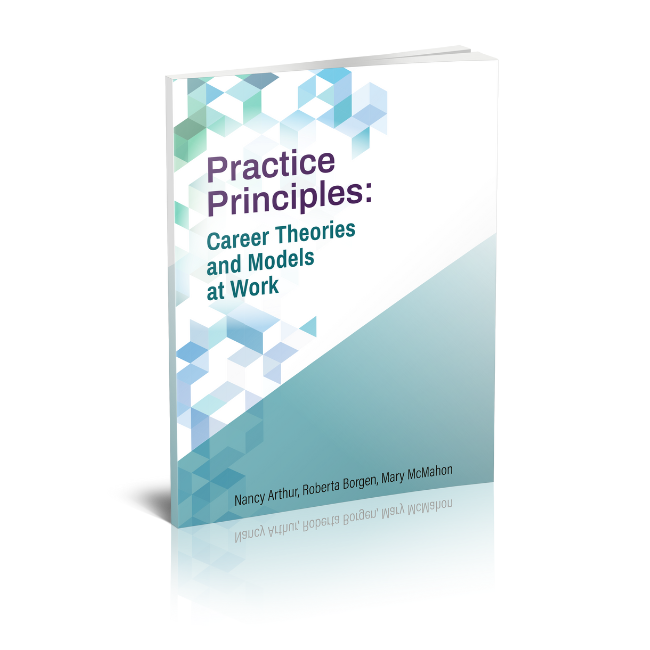
Author(s)
Nancy Arthur, Roberta Borgen (Neault) and Mary McMahon
Publisher
CERIC
ISBN
978-1-988066-73-8
Synopsis
Practice Principles: Career Theories and Models at Work provides career development practitioners with theory-informed principles for everyday application. It is a follow-up to the popular Career Theories and Models at Work: Ideas for Practice book. The new book fills a gap in the field that addresses foundational career practice principles, ensuring that techniques used by practitioners are underpinned by actual theory.
Career practitioners need to be equipped and up-to-date with the latest contemporary theories and models in the field. It is also important for practitioners to make informed choices about the approaches and strategies they use in practice. This book offers:
- A “go-to” guide outlining core foundational principles that every career practitioner can apply in their practice
- A reference practitioners can use to enhance their approaches to career interventions
- An accessible resource they can add to their toolkit or use as a companion manual to Career Theories and Models at Work: Ideas for Practice
Practice Principles is intended for both current practitioners and as well as those just entering the field, and can be used as a supplementary text for undergraduate and graduate courses focused on career counselling. The book includes 10 chapters that illuminate connections between foundational practice principles and the theories and models where they originated.
Published in 2019, the original Career Theories and Models at Work: Ideas for Practice book featured more than 60 authors from nine countries. This 43-chapter text has been translated into four languages and has been widely used nationally and internationally.
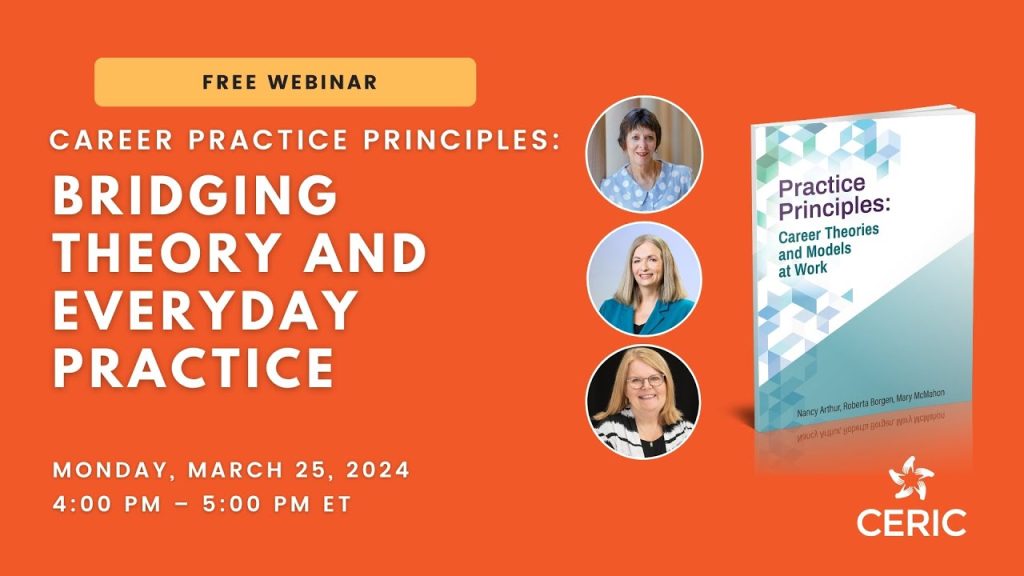
Free Webinar
Career Practice Principles: Bridging Theory and Everyday Practice
Nancy Arthur, Roberta Borgano, and Mary McMahon join a panel of career development experts hosted by CERIC to explain how to bridge theory and everyday practice through core principles that enhance client support across various career stages
Get your copy
About the author
Dr. Nancy Arthur is Dean of Research at UniSA Business, University of South Australia and Professor Emeritus, University of Calgary. Nancy’s research has focused on culture-infused career counselling and the transition experiences of international students and workers.
Dr. Roberta Borgen (Neault) is President of Life Strategies Ltd., home of the Career Management Professional program. She co-developed the Career Engagement model and is author/editor of several career development and counselling resources.
Dr. Mary McMahon is an Honorary Associate Professor at the University of Queensland, School of Education in Australia. Mary is a developer and co-author of the Systems Theory Framework of career development.
Publishing of the guide was made possible in part by the generous contributions of Knowledge Champions.



Blogs by the authors
Podcasts by the authors
Reviews
Book review by Charlotte George in the Asia Pacific Career Development Association Journal
Book review by Deirdre Hughes in the IAEVG Newsletter – June 2024
Dr. Rie Thomsen
Professor of Career Guidance, Aarhus University, Denmark
“This book is more than just a follow-up to Career Theories and Models at Work: Ideas for Practice (Arthur et al., 2019). Inside, you’ll find eight essential principles that offer a framework for practitioners of career guidance, counselling and consultation to metacognize their practice in a reflective and structured manner. These principles are equally beneficial for researchers seeking to connect their work with real-world applications. This exceptional book significantly elevates the quality of both practice and research.”
Paola Sallusti
Elementary Teacher, British Columbia, Canada
As an elementary school teacher, I know the importance of developing foundational skills in children. This is a hugely important part of my practice. This toolkit gives specific, practical teaching (and assessment!) strategies for developing skills such as collaboration, responsibility, and self-regulation. While there is a “career” focus to the toolkit, the truth is that these skills are useful in school, at home, and everywhere in life.
Adriano Magnifico
Career & Entrepreneurship Consultant, Louis Riel School Division, Manitoba, Canada
This career development in children toolkit, Exploring Possibilities! Journeying Through Career-Related Learning in Grades 4-6, is a comprehensive career development resource for elementary teachers. The toolkit offers detailed research to build a powerful rationale for using a career development lens in elementary school work and activities and reshapes the word “career” into a thoughtful and imaginative journey full of learning and experiences that ignites students’ life journeys.
Tricia Berry
Learning Specialist, Educational Support Services, Education and Early Childhood Development, Government of New Brunswick, Canada
The Exploring Possibilities! Journeying Through Career-Related Learning in Grades 4–6: A Teaching Toolkit is an important project in education but more specifically, in the area of elementary career education. The resulting teaching toolkit is a resource that can not only inform the practice of educators but to support a shift in mindset leading to the significant and intentional delivery of career development for elementary learners. The use of the toolkit will without a doubt have a lasting impact on the lives of our learners. It is with great hope that we will see its use across the relevant grades in allowing for more universally accessed career-connected learning.
Dr. Vicky Prévost
Assistant Professor, Educational Sciences – School of Counseling and Guidance, Université Laval, Quebec City, Canada
This toolkit offers an interesting perspective on career-related learning throughout Canada. Its innovative and creative activities can serve as inspiration for educators who wish to initiate and develop career-related skills within their community. The use of this toolkit can benefit students, helping them develop various facets of their lives, including healthy habits, social and emotional skills, self-confidence, and more, as they prepare to embrace their future.
Sareena Hopkins
Executive Director, Canadian Career Development Foundation, Ottawa, Canada
As research is increasingly pointing to the critical role of career development at earlier ages, this toolkit is such a timely resource. It offers a powerful blend of conceptual clarity, linkages to research, tailored strategies and practical tools/activities for classroom or community application. Any educator or career influencer working with children will want this toolkit as their go-to guide.
Professor Tom Harrison
Director of the Jubilee Centre for Character and Virtues, Deputy Pro-Vice Chancellor for Education Innovation, University of Birmingham, UK
This teaching toolkit offers valuable insights into the integration of career-related learning within elementary education. While its primary focus is on preparing young students for future opportunities, it subtly emphasizes the importance of cultivating foundational skills such as healthy habits, social and emotional competence, self-confidence, empathy and collaboration. These skills not only support career development but also contribute to character development and lifelong flourishing. By recognizing that elementary education plays a vital role in helping children discover their passions and aspirations, this toolkit aligns with our commitment to holistic individual development. It provides educators with a valuable resource to foster both career readiness and the long-term well-being of young minds.
Michele Murphy
Elementary Teacher and Certified Career Development Practitioner, Toronto, Ontario
Dr. Anthony Mann
Senior Policy Analyst (Career Readiness), Organisation for Economic Cooperation and Development
Teruyuki Fujita
Professor, Career Education, Institute of Human Sciences, University of Tsukuba, Japan
Rich Feller
Ph.D, LPC, JCTC, Professor, Counseling and Career Development and University Distinguished Teaching Scholar, Colorado State University and Exec. Dir. Career Development Network
Sareena Hopkins
Executive Director, Canadian Career Development Foundation (CCDF)
Heather Lowery-Kappes
National President, Career Development Association of New Zealand 2020-2023
Deirdre Hughes
Associate Professor, University of Warwick, Institute for Employment Research (IER) and Co-Founder of CareerChat UK Ltd.
Christopher John Beukes
Chief Executive Officer, South African Career Development Association
Karin Asplund
President, The Swedish Association of Guidance Counsellors
Zhi-Jin Hou
Professor, Faculty of Psychology, Beijing Normal University